When should an agent stop and ask a person?
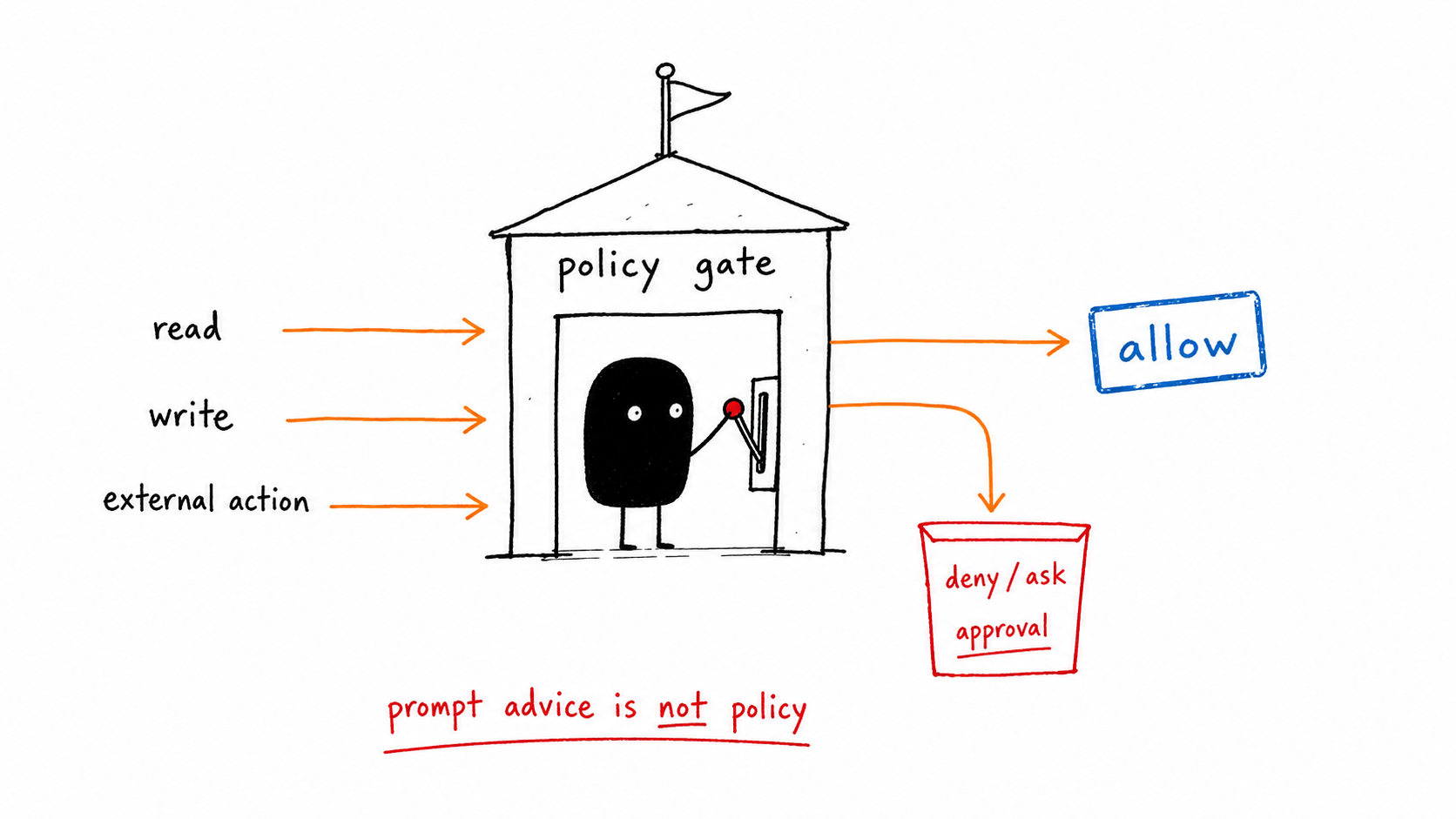
The tempting answer is to ask for approval whenever the action feels important. That answer is not useless, but it is too vague to operate. Human approval for AI agents is a runtime gate that pauses risky actions until a reviewer can inspect the request, evidence, policy result, proposed action, blast radius, and rollback path. Approval is useful only if the human sees enough context to decide.
Direct answer
Human approval for AI agents is a runtime gate that pauses risky actions until a reviewer can inspect the request, evidence, policy result, proposed action, blast radius, and rollback path. Approval is useful only if the human sees enough context to decide.
The common mistake
The sharper operating question is:
Where this gate sits
Human approval sits at the boundary between analysis and side effect. It should trigger before the irreversible or customer-visible action, not after the agent has already acted.
Signals to capture
| Signal | What to inspect | Gate action |
|---|---|---|
| Risk class | External, destructive, financial, regulated | Require approval |
| Evidence | Trace, sources, tool results, evals | Show packet |
| Proposed action | Exact send, write, deploy, charge | Preview before execution |
| Reviewer authority | Owner, approver, escalation role | Validate authority |
| Rollback | Undo or mitigation path | Block if missing |
Running example
A marketing agent wants to publish a pricing page update. The approval packet shows the diff, source notes, policy checks, screenshot, expected URL, rollback command, and open risks. The human approves the packet, not a vague request to publish.
Implementation checklist
- Define approval triggers by side effect and risk tier.
- Show exact action payloads, not summaries.
- Include trace, sources, policy, eval, and confidence evidence.
- Require reviewer authority for the domain being changed.
- Log approval decisions as trace events before execution.
What changes in production
In a demo, Human approval for AI agents can look like a reviewer preference. In production, it has to become a branch in the agent runtime.
The branch is simple: if the system sees “External, destructive, financial, regulated”, it should require approval. If it sees “Trace, sources, tool results, evals”, it should show packet. If it hits “The action is irreversible or externally visible”, the run should not continue as if nothing happened.
For Human approval for AI agents, that is the difference between a content checklist and a control gate. The gate changes the next action while the run is still alive.
What to log in the trace
approval_packet_idrisk_classreviewer_iddecisiondecision_reasonrollback_refaction_after_approval
Review packet
A reviewer, on-call owner, or future incident review should be able to answer three Human approval for AI agents questions from the packet:
- What evidence triggered this Human approval for AI agents gate?
- What action did this Human approval for AI agents gate allow, deny, retry, or escalate?
- What would have happened if the Human approval for AI agents gate had been absent?
For Human approval for AI agents, the packet should point directly at the trace fields above and the specific signal row that caused the decision. If the packet only says “agent requested approval” or “policy failed,” it is not yet operational evidence.
When to escalate
- The action is irreversible or externally visible.
- The reviewer cannot see the evidence behind the recommendation.
- The proposed action differs from the approved payload.
- The system cannot connect approval to the executed action.
Related control gates
- AI Agent Security: Threat Models for Tool-Using Agents
- AI Agent Governance: Approval, Audit, and Eval Gates
- MCP Authentication: Gate Agent Access to Tools Safely
- AI Agent Evaluation: Gates That Catch Bad Behavior
- AI Agent Control Gates: Stop Bad Agents Before They Act
Frequently Asked Questions
What is human approval for AI agents?
Human approval is a runtime pause before a risky agent action. A reviewer sees the evidence, policy result, proposed action, risk, and rollback path before approving, rejecting, or requesting changes.
When should agents require approval?
Require approval for customer-visible messages, destructive writes, deployments, payments, sensitive-data access, privilege changes, policy exceptions, and actions with unclear evidence.
What should an approval screen show?
Show the exact action payload, trace link, source evidence, tool outputs, policy result, eval result, risk class, owner, and rollback plan. Without those, the approval is too blind.
The Takeaway
Human approval is not a button after the agent has decided. It is a decision packet before the agent touches the world.